

Quick Answer
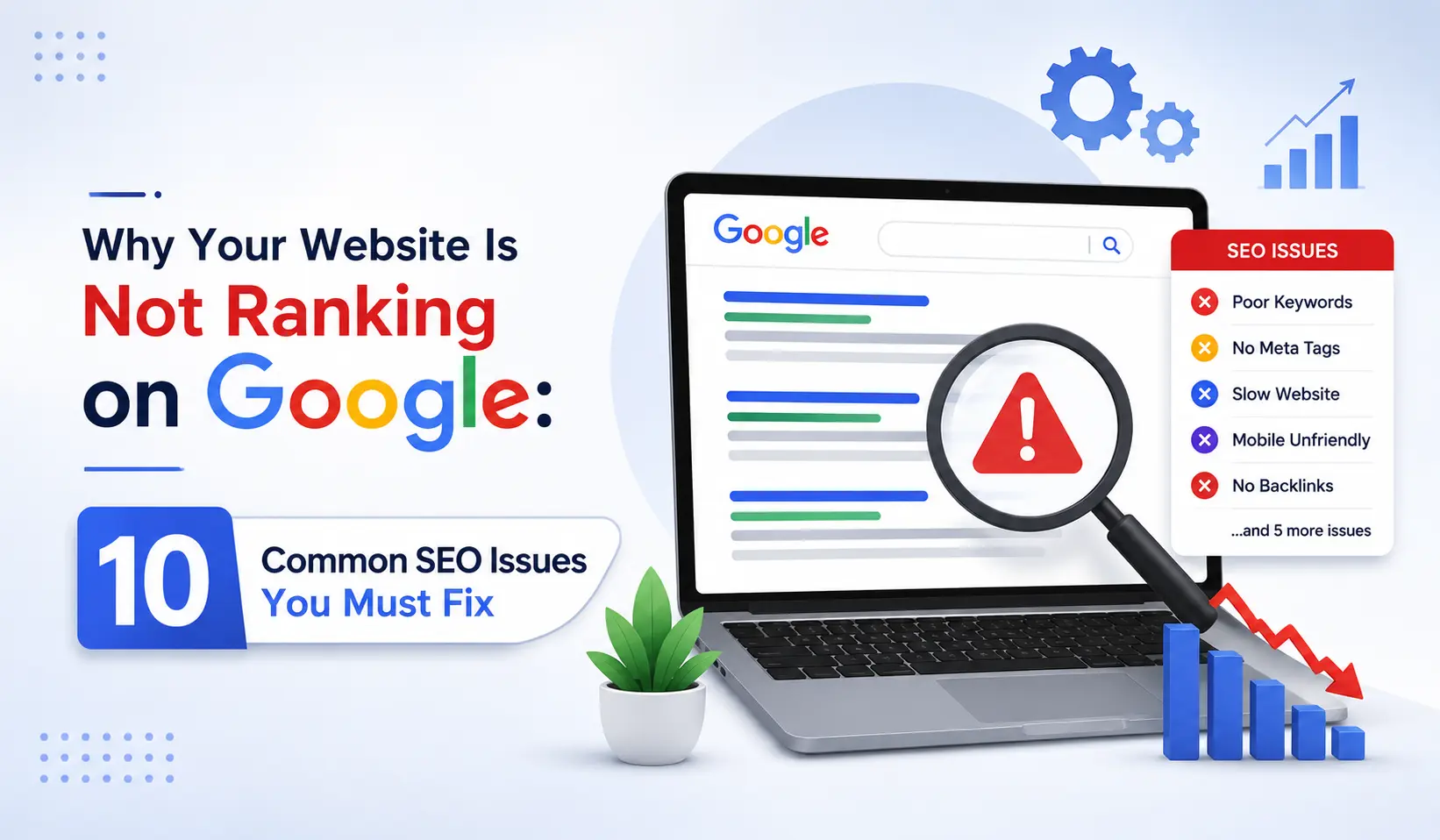
If your website is not ranking on Google, the most common reasons include poor technical SEO, weak content quality, slow website speed, indexing issues, poor user experience, lack of backlinks, keyword targeting mistakes, and increased competition. Identifying and fixing these issues can significantly improve your website’s visibility in search results.
Introduction
You launched your website, published content, optimised a few keywords, and waited for traffic to arrive. Yet months later, your website still isn’t appearing on the first page of Google.
If this sounds familiar, you’re not alone.
One of the most common questions business owners ask is:
“Why is my website not ranking on Google?”
The reality is that Google uses hundreds of ranking factors to determine which websites deserve top positions in search results. Even a single technical issue can prevent your website from achieving the visibility it deserves.
Over the years, our team at SRS Pro has audited websites across multiple industries, and we’ve discovered that ranking problems are usually caused by a combination of technical, content, and authority-related issues.
In this guide, we’ll break down the most common reasons websites fail to rank and explain how to fix them.
1. Your Website Is Not Properly Indexed
Before Google can rank your website, it must first discover and index your pages.
Many businesses unknowingly block search engines through:
- Incorrect robots.txt settings
- Noindex tags
- Crawl restrictions
- Broken sitemap configurations
How to Check
Search:
site:yourdomain.com
If your pages don’t appear, indexing may be the problem.
How to Fix It
- Submit your sitemap in Google Search Console
- Check robots.txt settings
- Remove accidental noindex tags
- Request indexing for important pages
2. You’re Targeting the Wrong Keywords
Many businesses target highly competitive keywords that are difficult to rank for.
For example:
Instead of targeting:
“Digital Marketing”
Consider:
“Digital Marketing Services in Ahmedabad”
Long-tail keywords often have:
- Lower competition
- Higher conversion rates
- Better local relevance
Best Practice
Focus on keywords that match user intent rather than simply targeting high-volume terms.
3. Your Content Doesn’t Meet Search Intent
Google’s goal is to provide users with the most helpful answer.
If someone searches:
“Why is my website not ranking on Google?”
and your page only talks about your services; Google will not view it as relevant.
Common Search Intent Types
- Informational
- Commercial
- Transactional
- Navigational
Your content should match the user’s intent precisely.
4. Technical SEO Issues Are Holding You Back
Technical SEO forms the foundation of search visibility.
Common issues include:
- Broken links
- Redirect errors
- Duplicate content
- Missing canonical tags
- Crawl errors
- Poor site structure
Why It Matters
Even excellent content may struggle to rank if technical SEO problems prevent Google from understanding your website.
Recommended Action
Perform a technical SEO audit at least once every quarter.
5. Your Website Loads Too Slowly
Page speed directly affects both rankings and user experience.
According to Google, users expect websites to load quickly. Slow websites often experience:
- Higher bounce rates
- Lower engagement
- Reduced conversions
Common Causes
- Large image files
- Excessive scripts
- Poor hosting
- Unoptimized code
How to Improve Speed
- Compress images
- Use caching
- Upgrade hosting
- Minify CSS and JavaScript
6. Your Website Is Not Mobile Friendly
Google primarily uses mobile-first indexing.
This means Google evaluates your mobile experience before considering desktop performance.
Common Mobile Problems
- Small text
- Poor navigation
- Slow loading speed
- Broken layouts
Why It Matters
A poor mobile experience can negatively impact rankings and conversions.
7. Your Website Lacks Authority and Trust
Google prefers websites that demonstrate expertise, experience, authority, and trustworthiness.
This concept is commonly known as EEAT:
Experience
Real-world knowledge and practical insights.
Expertise
Demonstrated understanding of a topic.
Authoritativeness
Recognition within your industry.
Trustworthiness
Transparency, credibility, and reliability.
Ways to Build Authority
- Publish expert content
- Showcase case studies
- Earn quality backlinks
- Display client testimonials
- Maintain accurate business information
8. Your Competitors Have Stronger SEO
Sometimes the issue isn’t your website.
It’s your competition.
Businesses ranking above you may have:
- More backlinks
- Better content
- Stronger domain authority
- Better user experience
What to Do
Analyse competitors and identify:
- Content gaps
- Keyword opportunities
- Link-building opportunities
This often reveals quick wins.
9. You Don’t Have Enough High-Quality Backlinks
Backlinks remain one of Google’s strongest ranking signals.
However, quality matters far more than quantity.
Valuable Backlinks Come From
- Industry websites
- Local business directories
- News publications
- Trusted blogs
Avoid
- Spammy links
- Purchased backlinks
- Low-quality directories
Google prioritizes relevance and trust.
10. Your SEO Strategy Is Inconsistent
Many businesses publish a few blogs and expect immediate results.
SEO doesn’t work that way.
Successful websites consistently:
- Publish valuable content
- Update existing pages
- Build authority
- Improve user experience
- Monitor performance
SEO is a long-term investment rather than a one-time task.
How Google’s AI Search Is Changing Rankings
Google’s AI-powered search experiences are changing how content is discovered.
Today, ranking success depends on more than keywords.
Content should:
- Answer questions directly
- Demonstrate expertise
- Include real-world insights
- Provide actionable solutions
This is why businesses should focus on creating helpful, experience-based content rather than keyword-stuffed articles.
How SRS Pro Helps Businesses Improve Rankings
At SRS Pro, we regularly work with businesses that struggle to improve search visibility despite investing time and resources into their websites.
Our SEO specialists help identify:
- Technical SEO issues
- Content gaps
- Indexing problems
- Website performance bottlenecks
- Local SEO opportunities
By combining technical expertise with data-driven strategies, we help businesses build sustainable search visibility and long-term organic growth.
For businesses in Ahmedabad, Gujarat, and across India, a structured SEO approach can make a significant difference in online visibility and lead generation.
Conclusion
If your website isn’t ranking on Google, the problem is rarely caused by a single factor.
Most ranking issues stem from a combination of:
- Technical SEO problems
- Weak content
- Poor user experience
- Lack of authority
- Inconsistent optimization
The good news is that every issue discussed in this guide can be fixed.
The key is identifying the root cause, prioritising improvements, and implementing a long-term SEO strategy focused on user experience, expertise, and value.
Businesses that consistently invest in SEO are far more likely to achieve sustainable rankings, traffic growth, and online visibility over time.
Frequently Asked Questions
Why is my website not showing up on Google?
Your website may not be indexed, may have technical SEO issues, or may not contain content that matches user search intent.
How long does it take for a website to rank on Google?
Most websites begin seeing SEO improvements within three to six months, depending on competition, authority, and optimisation efforts.
Can a new website rank on Google?
Yes. New websites can rank if they target relevant keywords, publish helpful content, and follow SEO best practices.
Does website speed affect rankings?
Yes. Slow-loading websites can negatively impact user experience and search rankings.
What is the most common SEO mistake?
One of the most common mistakes is creating content without understanding search intent and user needs.