
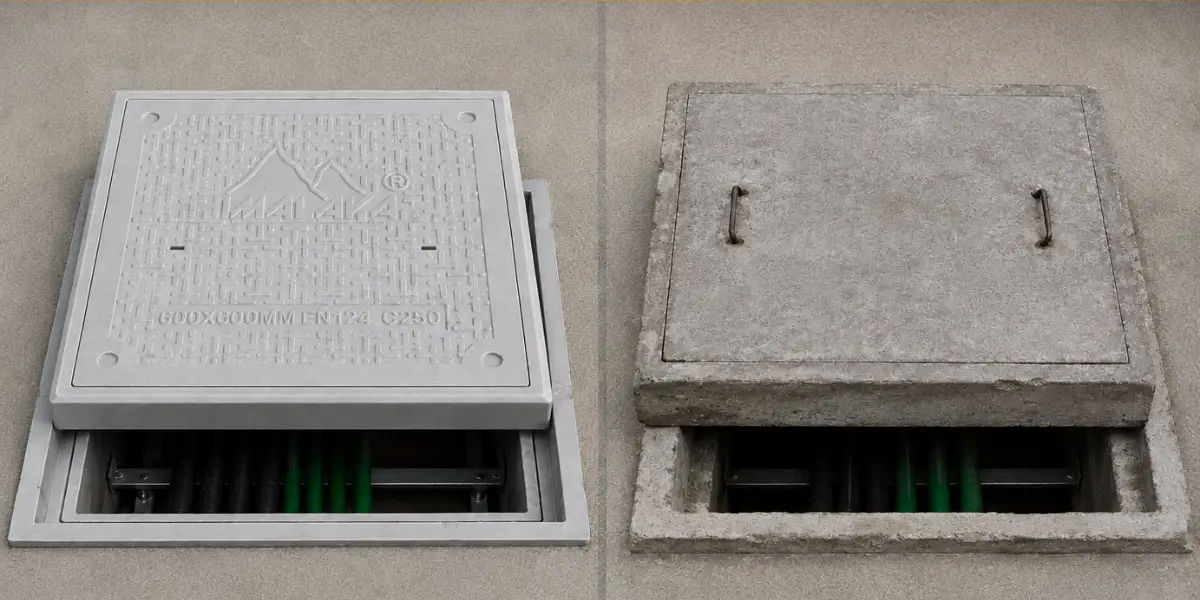
Introduction
Manhole covers are a critical component of urban infrastructure, providing access to underground utility chambers while supporting the loads imposed by pedestrian and vehicular traffic above. The two most common materials for manhole cover manufacturing in India are Fibre Reinforced Plastic (FRP) and Reinforced Cement Concrete (RCC). Each material offers distinct advantages depending on the application environment, required load class and project budget.
FRP Manhole Covers
FRP manhole covers, also known as GRP (Glass Reinforced Plastic) covers, are manufactured using glass fibres embedded in a polyester or epoxy resin matrix. The resulting composite material combines high strength-to-weight ratio with excellent corrosion resistance. Himalaya FRP covers are BS EN 124:2015 certified and available in D400 load class, making them suitable for carriageway applications.
Key Advantages of FRP Covers
The primary advantage of FRP covers over cast iron and concrete alternatives is their complete immunity to corrosion. In sewerage manholes, the H2S gas produced by anaerobic bacteria dissolves in moisture to form sulphuric acid, which rapidly corrodes both cast iron and bare concrete surfaces. FRP is completely immune to this attack, resulting in dramatically longer service life in aggressive environments.
FRP covers are approximately 60-70% lighter than equivalent cast iron covers and 40-50% lighter than RCC covers of the same size. This reduces installation effort and eliminates the need for mechanical lifting equipment in most situations, reducing project costs and improving worker safety.
In premium commercial and residential projects, FRP recess covers allow matching flooring materials to be laid over the cover, creating a seamless floor surface that is aesthetically superior to the conventional visible cover with contrasting frame.
RCC Manhole Covers
Reinforced Cement Concrete manhole covers offer a cost-effective solution for standard drainage and access chamber applications where corrosion is not a primary concern. Manufactured to IS 12592 using M30 grade concrete with steel reinforcement, RCC covers deliver reliable performance in municipal roads, housing layouts and industrial areas.
Key Advantages of RCC Covers
RCC covers are generally more economical than FRP covers for large-volume municipal procurement where budget constraints are paramount. For municipal corporations procuring thousands of units for city-wide drainage maintenance, the cost difference can be significant.
Concrete is a familiar material to civil construction teams. RCC covers require no specialised handling procedures beyond standard lifting equipment and can be laid and reset using conventional tools available on any construction site.
Specification Decision Matrix
For projects where corrosion resistance is critical such as sewerage networks, coastal areas, chemical industrial zones and ports, FRP covers should always be specified. The premium over RCC is justified by the dramatically longer service life and elimination of replacement costs.
For premium architectural projects such as hotels, airports and high-end commercial developments, FRP recess covers should be specified to achieve the seamless flooring requirement that cannot be achieved with RCC.
For standard municipal road drainage in non-corrosive environments where budget is constrained, IS 12592 certified RCC covers from a BIS licensed manufacturer such as Himalaya represent an excellent value solution.
Conclusion
Both FRP and RCC manhole covers have their place in infrastructure specification. The key is matching the material to the application environment, aesthetic requirements and lifecycle cost expectations of the project. Himalaya manufactures both product lines to BS EN 124:2015 and IS 12592 standards, allowing specifiers to source both cover types from a single trusted supplier with consistent quality certification.